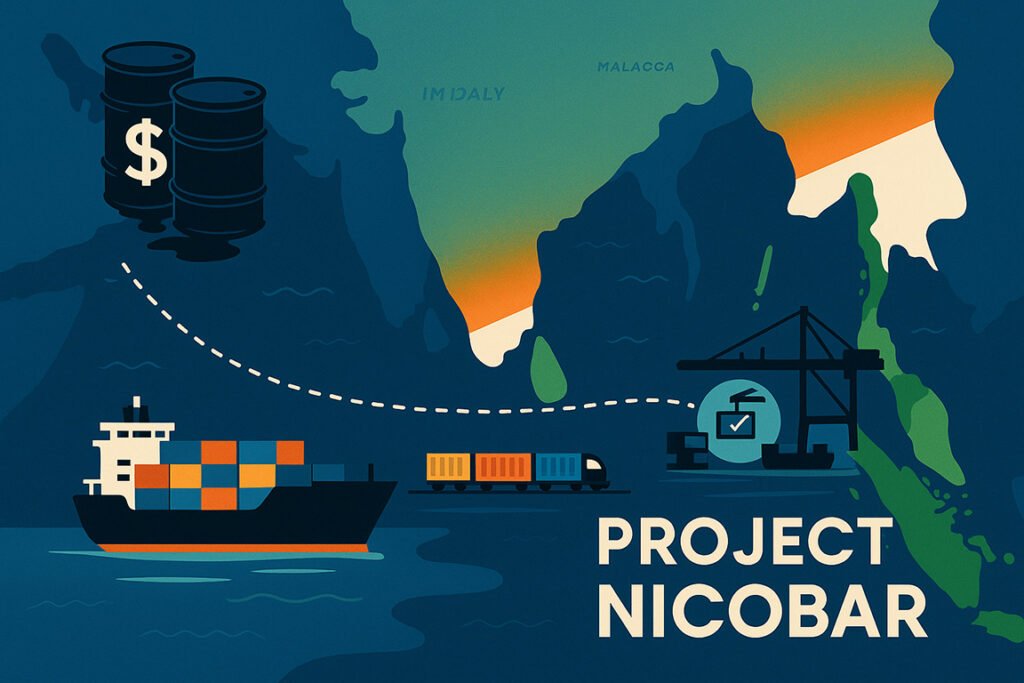
Project Nicobar: India’s Deep-Sea Bet on Growth, Security, and Strategic Autonomy
What is “Project Nicobar”?
“Project Nicobar” is the Government of India’s holistic development plan for Great Nicobar Island (GNI) in the Andaman & Nicobar archipelago. Its flagship asset is the International Container Transhipment Port (ICTP) at Galathea Bay, designed as a deep-water, global hub ~40 nautical miles from the Malacca Strait, one of the world’s busiest chokepoints. The port has natural depths >20 m, is planned under a landlord model, and targets ~4 million TEU in Phase-1 by ~2028 with an ultimate capacity near 16 million TEU; Phase-1 capex is projected around ₹18,000 crore within a larger port program of ~₹41,000–₹44,000 crore and a broader island plan (airport, township, power) sometimes cited at ₹72,000–₹81,000 crore over multiple components. ConstructionWorld, The Economic Times
Why here? GNI sits next to the Malacca–Lombok sea lanes used by Asia–Europe/US traffic. Today, India’s containers are heavily transshipped at Singapore, Port Klang, and Colombo; shifting part of that volume to an Indian hub can reduce time and cost while capturing value-added jobs in logistics and maritime services. pib.gov.in
Sarbananda Sonowal (Minister of Ports, Shipping & Waterways): opposition to the Great Nicobar transshipment project “smells of vested interest”; “all necessary clearances have been taken.” Outlook Business, DST – Daily Shipping Times
Why deep-water transhipment—historical & economic context
For decades, India under-invested in hub-class, 18–20 m ports, routing export–import boxes through foreign hubs. That made sense when scale economics, equipment, and feeder networks were thin. But India’s container base has since grown rapidly, and logistics reforms have improved competitiveness. The Andaman & Nicobar geography offers a rare Indian location with hub-class draft plus chokepoint proximity, a combination historically monopolised by Singapore and (more recently) Colombo/Klang pib.gov.in
Economic commentators note, however, that GNI construction costs can be 2.5–3× mainland levels, so tariff strategy and ecosystem building are critical. An engineering study cited by the Economic Times suggested introductory tariffs ~20% below Colombo to attract mainline calls. The Economic Times
Strategic logic: countering the “String of Pearls”
China’s so-called “String of Pearls”—commercial/dual-use footholds from Gwadar (Pakistan) to Hambantota (Sri Lanka) and beyond—seeks resilient sea-lane access across the Indian Ocean. Indian analysts have long flagged encirclement risks. Developing GNI as a major transhipment and dual-use facility strengthens India’s presence near Malacca, complements the Andaman & Nicobar Command, and supports sea-lane awareness and rapid response across the eastern IOR indiatimes, Lintner, Bertil (15 April 2019).
Media and policy analyses characterise GNI as a civil–military “Pearl Harbour”-style anchor for India’s eastern approaches, enhancing deterrence and maritime domain awareness—without depending on external hubs. India Today
What exactly will be built—and who is interested?
- Port (ICTP, Galathea Bay): landlord model; government-owned core assets; private concessionaire to operate terminals/equipment. Expressions of Interest (EOIs) have come from Adani Ports, JSW Infra, CONCOR, and international dredging/engineering majors, per official and trade-press reports. ETInfra.com,Construction World, Ports and Waterways Ministry
- Throughput & phasing: ~4m TEU in Phase-1, scaling toward ~16m TEU; commissioning target ~2028 for Phase-1 subject to financial close and construction. Construction World
- Complementary assets: new greenfield airport, power plant, and township to support the hub and resident workforce. India Today
Economic gains India is targeting
- Capture transshipment value now accruing abroad; reduce dependence on foreign hubs for Indian cargo Porecha, Maitri (19 January 2023).
- Lower system costs/turnaround times for exporters/importers via hub-proximity; scale feeding to Indian coasts. Porecha, Maitri (19 January 2023).
- Jobs & services ecosystem: tugs, pilots, bunkering, MRO, maritime insurance, ship-broking, digital trade services.
- Investor signal: EOIs from global players indicate interest if bankability (tariffs, volumes, reliability) is credibly addressed. ETInfra.com
A sober note from ET commentary: to compete with Singapore/Colombo, GNI may intro-price below rivals and ensure world-class reliability despite remote logistics and higher build/operating costs. The Economic Times
National security dividends
- Chokepoint adjacency enhances surge capacity for humanitarian assistance, disaster relief, and sea-lane security.
- Persistent presence complements radar/surveillance networks and allied exercises, and reduces the single-point failure risk if foreign hubs are disrupted by crisis or sanctions. Background analyses by maritime think tanks have long urged ANI development for both economic and military dividends. maritimeindia.org
The debate: environment and tribal rights
Critics warn the project’s footprint (variously cited across components) could harm primary rainforest, endemic species (e.g., leatherback turtles near Galathea), and the Shompen—a Particularly Vulnerable Tribal Group—whose isolation could be compromised. A 2024 open letter by scholars called the scheme a potential “death sentence” for the tribe if safeguards fail. The Guardian
The government counters that approvals followed “meticulous diligence,” that ~82% of GNI remains protected forest, and that Shompen displacement will not occur. Environment Minister Bhupender Yadav has publicly stated that tribal rights will be protected and framed the project as a response to Chinese expansionism in the IOR. The Indian Express,Business Standard,The Pioneer
Regulatory scrutiny is ongoing. In July 2025, the Centre submitted a sealed High-Powered Committee (HPC) report to the NGT reviewing clearances, citing national security sensitivities. The Times of India
Opposition voices have intensified. Sonia Gandhi called the plan a “misadventure” that threatens indigenous communities and the ecosystem; Jairam Ramesh has questioned seismic/tsunami risk assessments and due process. The Economic Times,Tehelka
How to reconcile growth, security, and rights: a practical mitigation stack
- Site & footprint optimisation
- Micro-site berths, breakwaters, and approach channels to minimise turtle nesting impacts, with no-go seasonal windows and dark-sky lighting near nesting beaches.
- Legally ring-fenced tribal buffers
- Statutory, GIS-defined exclusion zones and community-led health protocols to protect the Shompen from disease exposure; independent anthropologists on a permanent social-impact panel reporting to the NGT/Parliamentary committee.
- Biodiversity offsets that are real
- Like-for-like (or better) restoration of degraded areas elsewhere in ANI; marine protected areas adjacent to the terminal; fully funded turtle hatchery programs with scientific monitoring.
- Transparent monitoring
- Live dashboards on dredging, water quality, turbidity, nesting counts; third-party audits by Indian institutes + international peers; HPC summaries declassified to the maximum extent compatible with national security.
- Resilience by design
- Port civil works to accelerated tsunami/seismic codes, with redundant power/water and shelter-in-place plans for workers and local communities—explicitly addressing 2004-style scenarios critics highlight. Tehelka
How it plays into the China–India maritime competition
Developing a sovereign, dual-use hub at GNI counters the String of Pearls by anchoring Indian presence near Malacca, reducing reliance on third-country hubs, and giving New Delhi bargaining power in sea-lane governance. It complements the domestic hub strategy (Vizhinjam, JNPA upgrades) and India’s Act East/Indo-Pacific economic corridors. Porecha, Maitri (19 January 2023).
Voices for and against (ministers, opposition, analysts)
- For:
- Sarbananda Sonowal: “All necessary clearances… opposition smells of vested interest.” Outlook Business
- Environment Minister Bhupender Yadav: “Nod after meticulous diligence… tribal rights will be protected; the project will counter expansionism in the region.” The Indian Express, The Pioneer
- Industry/finance commentary stresses strategic centrality and export logistics gains—while advising introductory tariff discounts and reliability to win mainline calls. The Economic Times
- Against / cautionary:
- Sonia Gandhi: calls it a “planned misadventure” that threatens indigenous rights and ecology. The Economic Times
- Jairam Ramesh: flags tsunami/seismic and process concerns; urges fuller transparency. Tehelka
- Environmental scholars (open letter, 2024): warn of a potential “death sentence” for the Shompen if exposure risks are mishandled. The Guardian
- Strategic analysts:
- Think-tank assessments frame GNI as high-reward but execution-sensitive, urging phased development with hard environmental and social guardrails. ORF Online
What would success look like by the early 2030s?
- A reliable 4–6m TEU hub drawing mainline services—not just Indian feeder cargo.
- Measured tariff advantage (initially) versus Colombo/Singapore to seed volumes, then service-led stickiness. The Economic Times
- Dual-use readiness for HADR and Indo-Pacific contingencies, integrated with Andaman & Nicobar Command. maritimeindia.org
- Documented biodiversity & tribal safeguards (public dashboards, independent audits), creating a global template for sensitive-zone ports. The Times of India
Bottom line
Project Nicobar is India’s most ambitious maritime wager in decades: a chance to internalise transhipment, harden national security in the eastern IOR, and shape Indo-Pacific trade flows. The economics are credible if execution delivers reliability at competitive cost; the politics are sustainable only if India proves mega-infrastructure can coexist with tribal dignity and ecological stewardship. That is the bar—and the opportunity.