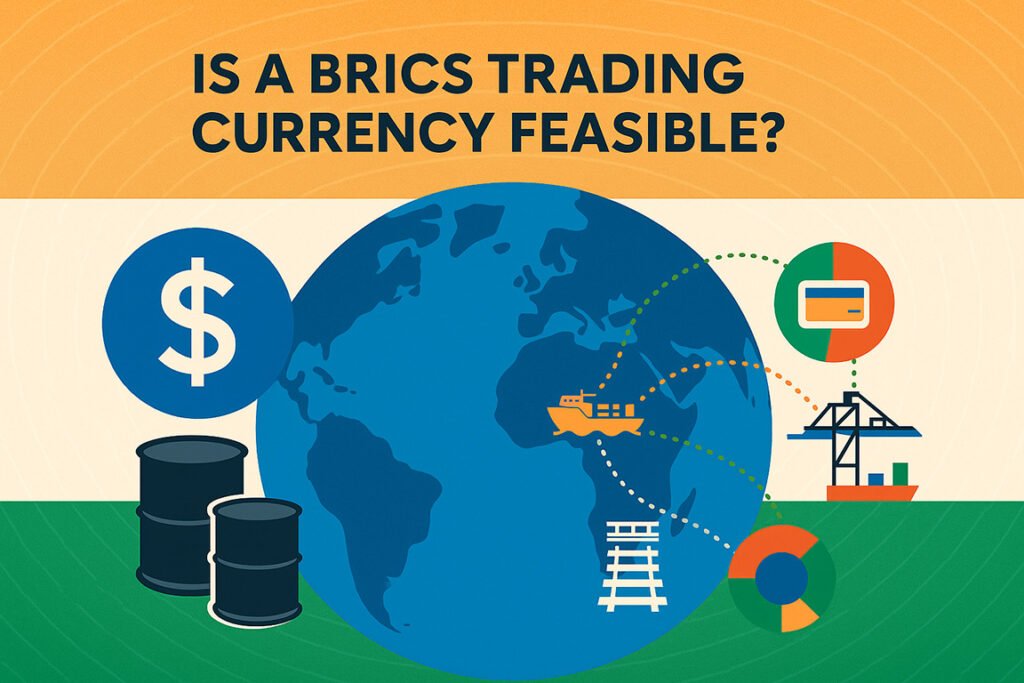
BRICS Trading Currency: Feasible, or a Mirage? History, Design Options, and Global Implications
Executive summary
Talk of a “BRICS currency” resurfaces whenever sanctions or tariffs rise. The core reality is that the U.S. dollar remains dominant because of deep, liquid markets, rule-of-law institutions, and network effects; yet the use of the dollar and the trading system as economic weapons (sanctions, export controls, payment plumbing) has nudged many countries to explore de-risking via local-currency trade, alternative payment rails, and even a BRICS unit of account. Recent BRICS communiqués and leaders’ remarks point to more trade in national currencies and new payment systems, while a single common currency is explicitly “premature.” Reuters+1TASS
I. How we got here: from sterling to Bretton Woods to the petrodollar
Bretton Woods and the dollar’s rise
In 1944, 44 countries built a system of fixed but adjustable exchange rates with the dollar pegged to gold at $35/oz; the IMF and World Bank were created to underwrite the system’s stability. The arrangement—dollar at the center, gold at the apex—cemented the greenback’s role as trade’s numéraire and primary reserve asset. federalreservehistory.org
The Nixon shock and fiat dollar dominance
In August 1971, President Nixon closed the gold window, ending official convertibility and ushering in the modern era of floating exchange rates—a profound break with Bretton Woods that nonetheless left the dollar on top thanks to market depth and U.S. scale. federalreservehistory.orgWikipedia
Petrodollars and post-1973 finance
From the early 1970s, oil priced mainly in dollars reinforced dollar demand and recycling into U.S. assets—popular shorthand: “petrodollar.” There was no single treaty mandating “dollars only,” but oil’s dollar invoicing entrenched dollar primacy. InvestopediaMarketWatch
II. The dollar as a tool of statecraft—and the blowback risk
The U.S. has increasingly used sanctions, export controls, and financial plumbing (e.g., dollar clearing, correspondent banking, SWIFT/CHIPS access) to pursue geopolitical aims. Janet Yellen has acknowledged a trade-off: overuse of sanctions can undermine dollar dominance over time. Business Insider Analysts across the spectrum argue that weaponization of finance pushes countries to build alternatives—even if dollar supremacy remains intact today. War on the Rocks, U.S. Department of the Treasury
European voices have likewise chafed at extraterritorial measures. EU High Representative Josep Borrell has warned about U.S. sanctions hitting European companies; President Macron has called for “strategic autonomy” so Europe is “rule-maker, not rule-taker.” EEAS, Bloomberg.com
III. What BRICS leaders actually say (not the headlines)
- Russia (Lavrov): a single BRICS currency is “premature”; focus instead on payments/settlements in national currencies and infrastructure to support that shift. TASSmid.ru
- India (Jaishankar): “No proposal for a BRICS currency”; India is not for de-dollarisation, while it does discuss practical local-currency settlements. Telegraph India, YouTube
- Brazil (Lula): advocates alternate means of payment and deeper financial integration to reduce vulnerabilities—without a hard commitment to a single currency. Reuters, Serviços e Informações do Brasil
- BRICS declarations (2024–25): emphasize greater use of national currencies and BRICS Pay / payment systems; no firm path to a monetary union. Reuters, Financial Times, The Economic Times
- China (PBoC/Xi): pushes yuan internationalisation, CIPS, digital-yuan infrastructure, and calls for reform of global governance—again, not a BRICS currency per se. Reuters, South China Morning Post, CGTN News
Bottom line: the energy is around payments and local-currency use, not a euro-style currency.
IV. Is a BRICS trading currency feasible? Three architectures
Option A — Trade unit of account (ECU-style “R5”)
A basket-based unit of account (like Europe’s pre-euro ECU) could price intra-BRICS trade without replacing national monies. Weights could reflect GDP, trade shares, and stability criteria; NDB could issue R5-denominated bonds, and BRICS CRA could back liquidity. Pros: minimal sovereignty loss; Cons: governance, reweighting politics, thin markets at first. India Foundation, IMF eLibrary, Valdai Club
Option B — Interoperable payments + settlement rails (BRICS Pay)
A messaging + settlement layer linking national RTGS systems (and CIPS for RMB) with common rules and sanctions-resilient messaging, possibly DLT-based. Think “SWIFT-lite + multilateral FX netting” not a currency, but removes frictions. Pros: fastest to ship; Cons: governance, AML/CFT alignment, FX risk remains. Lowy Institute, Juniper Research, Ledger Insights
Option C — CBDC corridor / mBridge-style hub
A multi-CBDC corridor where BRICS central banks settle in tokenised central-bank money with PvP (payment-versus-payment) and DvP (delivery-versus-payment). Pros: lowest counterparty risk; Cons: heavy regulatory and tech coordination; convertibility constraints (notably for RMB) limit offshore uptake. Federal Reserve
Feasibility verdict: A and B are realistic in 2–5 years; C is a longer-horizon play. A single currency is not feasible soon without converging inflation, fiscal, capital-flow regimes—which don’t exist across BRICS.
V. What the numbers and experts say about dollar durability
Economist Barry Eichengreen notes that dollar dominance erodes gradually, anchored by network effects and market depth; the likelier steady state is a more multipolar reserve system, not a sudden dethroning. Project Syndicate, Project Syndicate, Financial Times.
Eswar Prasad stresses that without capital-account liberalisation and a freely floating currency, the renminbi’s global role will remain constrained. Federal Reserve, IMF. On the other side, Zoltan Pozsar argues the commodity-security nexus is birthing a “Bretton Woods III” where outside money (commodities) and non-Western finance matter more. static.bullionstar.com, No Bullshit Bitcoin
VI. Benefits and drawbacks—by constituency
A. BRICS and BRICS+
Benefits
- Sanctions resilience & bargaining power: local-currency trade + alternative rails reduce single-point-of-failure risk (CHIPS/Swift). Financial Times
- FX risk & financing diversity: NDB local-currency lending target ~30% reduces currency mismatch for infrastructure borrowers. NDB+1
- Industrial policy alignment: pricing energy, agri, and critical minerals in a BRICS unit of account could stabilise intra-bloc terms of trade. Valdai Club
Drawbacks
- Convertibility & trust: capital controls (notably China), data-sharing/AML concerns, and uneven macro credibility impede adoption. Federal Reserve
- Governance politics: weightings, dispute resolution, and lender-of-last-resort roles could be contentious among unequals.
- Market depth: without deep bonds/derivatives in the new unit, hedging stays costly; users default back to USD.
B. United States & allies
Benefits
- Systemic resilience through competition: Western policymakers argue that upgrading cross-border tech and CBDC-friendly rails keeps the dollar system attractive. Financial Times
- Policy discipline feedback: awareness that overusing sanctions carries dollar-erosion risk may encourage more selective statecraft. Business Insider
Drawbacks
- Erosion at the margins: some trade invoicing and reserves diversification will continue to creep away from USD (a slow grind, not a cliff). Project Syndicate
- Dual-track finance: parallel payment pipes complicate enforcement of sanctions/export controls.
C. Wider world (non-aligned, developing economies)
Benefits
- Cheaper, faster settlement options and more currency choice; less spillover from great-power disputes into trade finance. Lowy Institute
Risks - Fragmentation: incompatible standards, multiple KYC/AML regimes, and shallow hedging markets could raise transaction costs for SMEs.
VII. A credible, phased implementation roadmap (what BRICS could actually do)
Phase 1: “Plumbing first” (0–24 months)
- BRICS Pay messaging layer + common compliance rulebook (KYC/AML, sanctions lists limited to UN scope).
- Local-currency settlement corridors with netting at central banks; expand swap lines; publish transparent FX fixing methodologies. Lowy Institute,Ledger Insights
- NDB scale-up of local-currency lending/issuance (hit 30% target), with R5 as a reporting unit/benchmark. NDB
Phase 2: “ECU-style unit of account” (2–5 years)
4) Launch R5 (basket) as a unit of account for invoicing and bonds; weights reflect GDP/trade/volatility.
5) Create a centralised R5 FX swap window (NDB/CRA) for liquidity backstops; publish the R5 yield curve via benchmark bonds. India Foundation,Valdai Club
Phase 3: “Tokenised settlement” (3–7+ years)
6) Pilot a multi-CBDC corridor for PvP/DvP with atomic settlement across member RTGS, harmonising data/settlement finality rules. Federal Reserve
7) Only if macro regimes converge (inflation, fiscal, capital flows) consider wider monetary integration—not before.
VIII. What key actors are signaling—quotes you can cite
- Sergey Lavrov (Russia): “Premature to discuss a transition to a single currency for BRICS… we can revisit once necessary conditions are in place.” TASS
- S. Jaishankar (India): “India has never been for de-dollarisation… no proposal for a BRICS currency,” while supporting discussions on financial transactions among BRICS. Telegraph IndiaYouTube
- Kremlin (Jan 2025): “BRICS is not planning its own currency; focus is on joint investment platforms and national-currency trade.” Reuters
- BRICS leaders (Kazan 2024): back national-currency use and alternative payment systems (grain exchange, payments). Reuters
- Janet Yellen (U.S.) acknowledges risk that sanctions linked to the dollar can undermine its dominance over time. Business Insider
- Emmanuel Macron (France) presses for European strategic autonomy—Europe should be “rule-maker, not rule-taker.” Bloomberg.com
- PBoC / Pan Gongsheng (China) emphasises stable yuan and steps to boost cross-border yuan use (including new operations centres and encouraging SOEs to settle in RMB). ReutersSouth China Morning Post
- Barry Eichengreen (economist) expects gradual erosion toward a multipolar reserve system, not a sudden dollar collapse. Project Syndicate
- Zoltan Pozsar (macro strategist) argues for an emerging “Bretton Woods III” centered on commodities and outside money. static.bullionstar.com
IX. India’s position and interests
New Delhi’s stance is pragmatic: expand rupee settlement where feasible and upgrade payment rails, but avoid anti-dollar crusades or a hasty monetary union. RBI and the government have been internationalising the rupee via bilateral arrangements (e.g., UAE) while keeping BRICS currency talk at bay. This multi-alignment preserves autonomy and optionality. The Times of India
X. What this means for policy (actionable takeaways)
- Prioritise rails over a new coin. The fast, feasible win is interoperable payments + local-currency trade; a shared unit of account can follow. Lowy Institute
- Governance, not hype. Any basket/R5 must have transparent rules (weights, data, audits), credible backstops (CRA/NDB), and market-making (benchmarks, swaps). Valdai Club
- Mind convertibility. Without capital-account openness and FX flexibility, uptake will plateau, especially for RMB-centric designs. Federal Reserve
- West: Upgrade, don’t just warn. To keep the dollar system attractive, the U.S./EU should modernise cross-border tech, temper sanctions overreach, and deepen markets, as many Western analysts now advise. Financial Times
Conclusion: feasible path, limited ambition
A full BRICS currency is not on the near-term agenda; key members say so. But a BRICS trade unit of account + alternative payment rails is feasible and already in motion. Expect incremental de-risking from the dollar—not dethronement. The destination is a more multipolar monetary system, shaped less by ideology than by plumbing, convertibility, and credible governance.